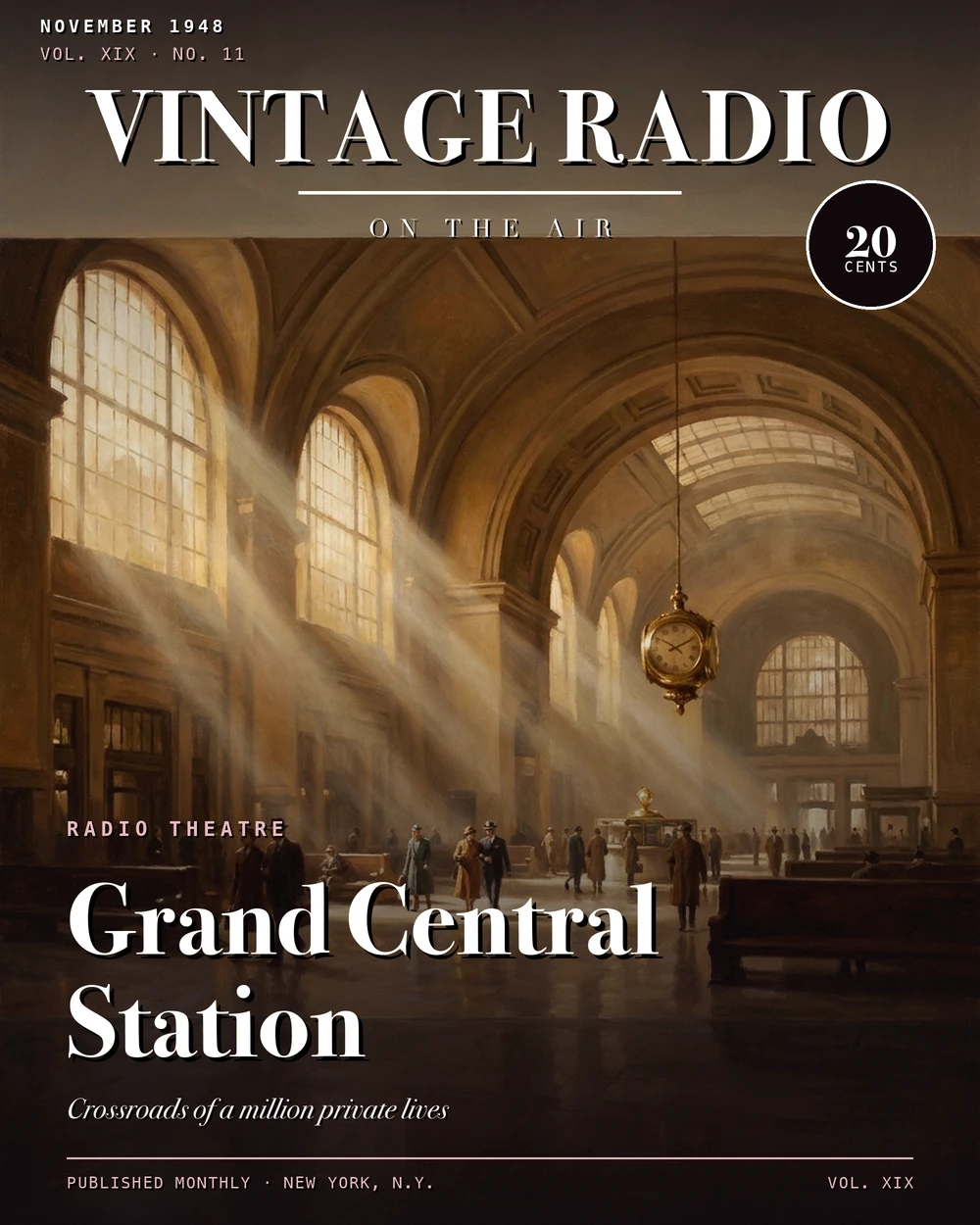
Grand Central Station
An Opening That Outlasted Everything Else
Grand Central Station is remembered less for any single story it told than for the sixty seconds that announced each episode. Trains from across the country rushing toward New York, sweeping down the Hudson for 140 miles, passing tenement houses south of 125th Street, diving into a two-and-a-half-mile tunnel beneath Park Avenue — and then the payoff: "Grand Central Station! Crossroads of a million private lives! Gigantic stage on which are played a thousand dramas daily!" That announcement, delivered over the rumble of steam locomotives and Alfred Newman's "Street Scene" theme, is among the most recognizable signatures in radio history. It's the kind of opening that makes you sit up straight, and it's been pulling people in since October 8, 1937.
Newman's theme, originally composed for the 1931 Samuel Goldwyn film of the same name, was his first complete film score and had become a widely recognized musical shorthand for New York City life by the time the show adopted it. Underneath the elevated prose of the opening monologue — with its talk of "shining rails in every part of our great country aimed at Grand Central Station, heart of the nation's greatest city" — the music grounded every episode in a particular New York sound and texture. The irony, as any New Yorker knew, is that Grand Central is officially a terminal, not a station. The show got the name wrong from the start, and nobody seemed to mind.
Once the opening concluded, the episode typically left Grand Central behind entirely. A passenger departing the terminal was used as a loose framing device, and then the drama unfolded on its own terms — light comedies, fluffy romances, and occasional O. Henry-style stories with psychological twists and surprise endings. The show was designed mainly for a daytime audience, and its consistently happy endings reflected that. The train station was atmosphere, not plot.
How It Moved Around the Dial
Few radio programs of the era changed hands as often as Grand Central Station. It premiered on the Blue Network with Listerine as sponsor, then migrated to CBS in April 1938, where Listerine continued to back it through October 1940. It bounced back to the Blue Network under Rinso sponsorship in late 1940, returned briefly to CBS in the summer of 1941, then moved to NBC — still with Rinso — from October 1941 through July 1942. After a gap, it resurfaced on CBS in March 1944 and stayed there for nearly a decade, a long Saturday morning run in various timeslots between 11 a.m. and 1 p.m. Pillsbury sponsored it from 1944 to 1951, Toni from 1951 to 1952, and Cream of Wheat from 1952 to 1953. The show's final run, on ABC with Campbell Soups as sponsor, lasted from January 18 to April 2, 1954, in a trimmed 25-minute weekday format.
The sponsor history tells a story about the show's audience. Listerine, Rinso, Pillsbury, Toni, Cream of Wheat, Campbell Soups — these were household staples, and the companies buying time on Grand Central Station were consistently aiming at home listeners with domestic routines. The Pillsbury years produced one of the show's odder touches: commercial messages delivered from an echo chamber to create the illusion of an announcer speaking inside a giant train terminal. "All aboard for better baking, finer cakes… you're on the right track with Pillsbury Sno-Sheen Cake Flour!" The commercials were as theatrical as the opening.
The People Behind It
The show was produced entirely in New York City, drawing on the city's radio talent pool for its writers, directors, actors, and crew. Among the producers, Himan Brown left the deepest mark. Born July 21, 1910, in the Brownsville section of Brooklyn, Brown grew up in a Yiddish-speaking household — his parents had emigrated from near Odessa, Ukraine, and his father worked as a tailor. He first learned about radio from a shop teacher at Brooklyn's Boys High School, and by age 18 he was broadcasting on WEAF, reading newspapers in a Yiddish dialect.
Brown earned a law degree from Brooklyn Law School in 1931, graduating as valedictorian, and used those credentials to acquire radio rights to fictional properties including Dick Tracy, Bulldog Drummond, Flash Gordon, and the Thin Man. While at Brooklyn College, he recruited a fellow student named Irwin Shaw to write scripts for him — giving Shaw his first paid writing job. Shaw later based a character on Brown in his 1951 novel The Troubled Air. Brown's talent for memorable radio signatures was notable enough that the Museum of Broadcast Communications specifically called them "classics," citing the steam train of Grand Central Station alongside the sirens of Dick Tracy and the creaking door of Inner Sanctum. Over a career spanning more than 65 years, he produced more than 30,000 radio programs and was inducted into the Radio Hall of Fame in 1990. He died on June 4, 2010.
Among the narrators, Alexander Scourby brought particular distinction to the role. Born November 13, 1913, in Brooklyn, to Greek immigrant parents, Scourby entered radio in 1939 and by the early 1940s was holding recurring roles on five serial dramas simultaneously. After radio, he became especially well known for recording the entire King James Version of the Bible for the American Foundation for the Blind's Talking Books program — nearly 500 books for the blind over his career. Jack Arthur served as the longtime narrator, with Stuart Metz also in rotation, while the announcer roster included Tom Shirley, George Baxter, and Ken Roberts.
Roberts is worth a moment. Born Saul Trochman on February 22, 1910, in Manhattan, he changed his professional name because he felt his birth name would not "sound so Jewish" in the broadcasting world. He won a full-time CBS staff announcer position in 1931, beating out 40 other applicants, and stayed with CBS for roughly two decades. His credits extended well beyond Grand Central Station — he announced for The Shadow during the 1937–38 season when Orson Welles played the lead role, and worked on Easy Aces, Joyce Jordan M.D., Quick as a Flash, and It Pays to Be Ignorant. In 1935, he founded the American Guild of Radio Announcers, which eventually evolved into AFTRA. Decades later, he appeared as an off-screen announcer in Woody Allen's Radio Days (1987), a film that also starred his son, the actor Tony Roberts. Roberts died on June 19, 2009, at age 99.
The acting roster was a rotating anthology cast typical of the format: Helen Claire, Frances Reed, Hume Cronyn, Arnold Moss, Roger DeKoven, Sydney Smith, Nancy Coleman, Martin Ashe, and Jim Ameche appeared in various episodes, among many others. Sound effects shifted with the networks — Ed Blainey at NBC, James Rogan and Frank Mellow at CBS, Harold Johnson Jr. at ABC. Bill Rousseau and Ira Ashley handled directing duties.
The Christmas Episode and What Survived
One program found a longer life than most: "Miracle for Christmas," about a bitter man's return to faith, became the show's annual Christmas offering and was broadcast year after year. A surviving script confirms it aired on December 24, 1949, identified as "the sixth annual Pillsbury presentation of Grand Central Station's traditional Christmas drama," with Galen Drake as the Pillsbury commercial announcer and Ken Roberts as narrator. The phrase "sixth annual" places the Christmas tradition back to roughly 1944, when Pillsbury came on as sponsor.
The broader survival picture is less generous. The show ran for nearly 17 years, but relatively few episodes survived — a significant gap between a program's broadcast life and what remained of it. The episodes that do survive reflect the show's general character: light drama with a gentle, soap-opera quality and the kind of consistent optimism that suited a Saturday morning audience.
Himan Brown had a pointed response when listeners complained that steam engines no longer ran into Grand Central Terminal. "You have your own Grand Central Station," he told them — meaning the station of the imagination, where the drama lived. It was a neat summary of what the show actually offered: not accuracy, not weight, not ambition, but a reliable weekly transportation into a certain kind of New York story, framed by one of radio's most effective openings.
The Television Pilot That Didn't Take
In 1952, a half-hour television pilot was produced based on Grand Central Station, but no network picked it up. The pilot starred Mercedes McCambridge, with supporting roles by Kirby Grant — soon to be famous as the star of the TV western Sky King — and Parley Baer, who played Chester on radio's Gunsmoke. Don W. Sharpe produced, the film opened with a montage of trains entering Manhattan, and the script used the same opening words as the radio program.
McCambridge was one of the most prominent radio actresses of the era. Orson Welles had called her "the world's greatest living radio actress," and by the time of the pilot she had already won the Academy Award for Best Supporting Actress for All the King's Men (1949). Her presence suggests the project was taken seriously, even if the networks ultimately passed. The show continued its radio run for another two years after the pilot was made, ending its broadcast life on ABC on April 2, 1954.